
Zulu (ZU) line
| Zulu (ZU) | |
|---|---|
| Line of the Transitica Railway Network | |
 | |
| Number | ZU |
| Type | High-speed rail |
| Color | #FF80D9 |
| Operator | ShmarLink |
| Division | Shmar Outer (commuter rail) |
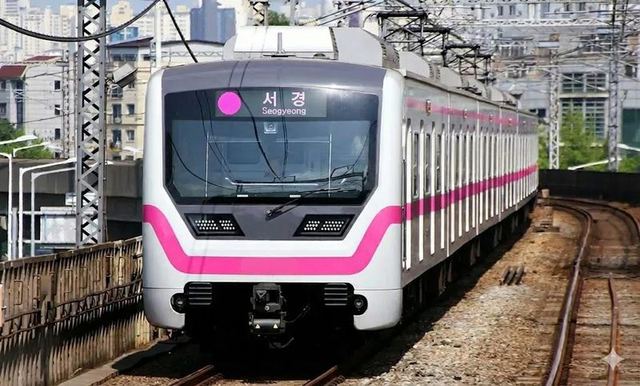
| Rolling stock | Seoul Metro 2000 Series (3rd generation) |
| Termini | Shmar Union Station Seogyeong |
| Stations | 16 |
| Length | 26,390 blocks (26.4 km) |
| Dimension | minecraft/overworld |
The Zulu (ZU) Line, numbered ZU, is a commuter rail line part of ShmarLink in the Transitica Railway Network. It runs between Shmar Union Station and Seogyeong, serving 16 stations over about 26.4 km.
Route
| Station | Connections | Platforms | km | |
|---|---|---|---|---|
| Shmar Union Station |     | 7 | 0.0 | |
| Glenmont | ▼1 ▲2 | 1.8 | ||
| Wheaton | ▼1 ▲2 | 4.6 | ||
| Forest Glen | ▼1 ▲2 | 7.2 | ||
| Silver Spring | ▼1 ▲2 | 9.9 | ||
| Takoma |   | ▼1 ▲2 | 12.2 | |
| Fort Totten | ▼1 ▲2 | 15.2 | ||
| Brookland - CUA | ▼1 ▲2 | 17.4 | ||
| Rhode Island Avenue | ▼1 ▲2 | 18.8 | ||
| NoMa - Gallaudet U | ▼1 ▲2 | 20.5 | ||
| Washington D.C. Union Station | ▼1 ▲2 | 21.5 | ||
| Judiciary Square | ▼2 ▲1 | 22.7 | ||
| Gallery Pl - Chinatown | ▼1 ▲2 | 23.3 | ||
| Metro Center | ▼1 ▲2 | 23.8 | ||
| Gunhang | ▼1 ▲2 | 25.4 | ||
| Seogyeong |   | ▼2 ▲1 | 26.4 |

History
The line was first planned as the SML Zulu Line (), a commuter rail line of the ShmarLink (Shmar Outer (commuter rail)) with 16 stations between Shmar Union Station 🚆 and 서경 (Seogyeong) 🚆.
Rolling stock
The line's trains are modelled on the Seoul Metro 2000 Series (3rd generation) (see Transitica rolling stock).
History
Seoul Subway Line 2 is the city's busy circular line, and since 2005 Seoul Metro has been replacing its original 1980s trains with a new generation of 2000-series cars. They have been built in batches: Hyundai Rotem built the first in 2005 and a large second batch in 2007–2008; Dawonsys built 200 cars (20 trains) in 2017–2018; Hyundai Rotem built 214 more in 2019–2020; and Dawonsys added cars in 2020–2022 for the branch lines. More than 700 cars are now in service, kept at Sinjeong and Gunja depots. The newer batches from 2017 onwards, which replaced the last of the original trains, are often counted as a third generation.
Design and features
The trains have stainless-steel bodies, four pairs of doors per side, IGBT drives with AC motors and regenerative braking, and automatic train control and operation. On the main loop they run as ten-car trains; the Seongsu and Sinjeong branches use shorter four-car and six-car sets.
Specifications
| Real-world train | |
|---|---|
| Manufacturer | Hyundai Rotem, Dawonsys |
| Built | 2005–2022 (newer batches 2017–2022) |
| Entered service | 2005 (newer batches from 2018) |
| Number built | over 700 cars |
| Formation | 10 cars (main loop); 4 or 6 cars on branches |
| Maximum speed | 80 km/h (50 mph) in service; 100 km/h design |
| Electric system | 1,500 V DC overhead line |
| Signalling | ATC, ATO |
| Car length | 19.5 m (64 ft) |
| Width | 3.16 m (10 ft 4 in) |
| Doors | 4 pairs per side |
| Traction | IGBT–VVVF, AC induction motors |
| Track gauge | 1,435 mm (4 ft 8½ in) |
In Transitica
How the line's trains are set up in the game:
- Cars: 9
- Car Length: 19.5 m (64 ft)
- Platform Length: 172 m (564.3 ft)
Source: Seoul Metro 2000 series (2005) on Wikipedia.