
Zulu (ZU) line: Difference between revisions
| Revision as of 20:23, 25 November 2026 claude (Seoul trains: rewrite rolling stock sections from Namu Wiki) | Revision as of 20:26, 25 November 2026 claude (Rolling stock: in-world history of how each line's agency got its trains, tied to the real orders) | ||
|---|---|---|---|
| Line 37: | Line 37: | ||
| + | ShmarLink's outer commuter line, the Zulu line, is built to Seoul Line 2 standards, and ShmarLink ordered its nine-car trains in the same 2016 tender as Seoul Metro's new Line 2 trains, built by Dawonsys. | ||
| + | |||
Revision as of 20:26, 25 November 2026
| Zulu (ZU) | |
|---|---|
| Line of the Transitica Railway Network | |
 | |
| Number | ZU |
| Type | High-speed rail |
| Color | #FF80D9 |
| Operator | ShmarLink |
| Division | Shmar Outer (commuter rail) |
| Rolling stock | Seoul Metro 2000 Series (3rd generation) |
| Termini | Shmar Union Station Seogyeong |
| Stations | 16 |
| Length | 26,390 blocks (26.4 km) |
| Dimension | minecraft/overworld |
The Zulu (ZU) Line, numbered ZU, is a commuter rail line part of ShmarLink in the Transitica Railway Network. It runs between Shmar Union Station and Seogyeong, serving 16 stations over about 26.4 km.
Route
| Station | Connections | Platforms | km | |
|---|---|---|---|---|
| Shmar Union Station |     | 7 | 0.0 | |
| Glenmont | ▼1 ▲2 | 1.8 | ||
| Wheaton | ▼1 ▲2 | 4.6 | ||
| Forest Glen | ▼1 ▲2 | 7.2 | ||
| Silver Spring | ▼1 ▲2 | 9.9 | ||
| Takoma |   | ▼1 ▲2 | 12.2 | |
| Fort Totten | ▼1 ▲2 | 15.2 | ||
| Brookland - CUA | ▼1 ▲2 | 17.4 | ||
| Rhode Island Avenue | ▼1 ▲2 | 18.8 | ||
| NoMa - Gallaudet U | ▼1 ▲2 | 20.5 | ||
| Washington D.C. Union Station | ▼1 ▲2 | 21.5 | ||
| Judiciary Square | ▼2 ▲1 | 22.7 | ||
| Gallery Pl - Chinatown | ▼1 ▲2 | 23.3 | ||
| Metro Center | ▼1 ▲2 | 23.8 | ||
| Gunhang | ▼1 ▲2 | 25.4 | ||
| Seogyeong |   | ▼2 ▲1 | 26.4 |
History
The line was first planned as the SML Zulu Line (), a commuter rail line of the ShmarLink (Shmar Outer (commuter rail)) with 16 stations between Shmar Union Station 🚆 and 서경 (Seogyeong) 🚆.
Rolling stock
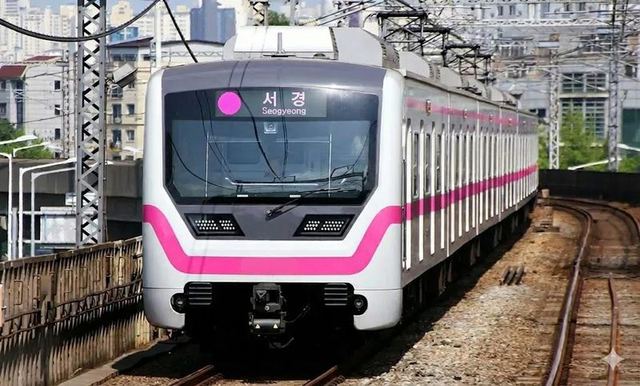
The line's trains are modelled on the Seoul Metro 2000 Series (3rd generation) (see Transitica rolling stock).
History
Seoul Subway Line 2, the city's circular line, has been re-equipped since 2005 with VVVF-controlled 2000-series trains, bought in five batches. Rotem (later Hyundai Rotem) built the first in 2005 and a large second batch in 2007–2008. The newer generation began with the third batch: 20 ten-car trains built by Dawonsys, delivered between 14 April 2017 and 3 December 2018 to replace 1980s–90s chopper-controlled trains. The new train was unveiled on 24 May 2017, and the first set, 206, entered service on 30 September 2017. It was Dawonsys's first big subway order, breaking Hyundai Rotem's near-monopoly, and railway fans welcomed it. Trains from set 211 onwards carry the new Seoul Metro (Seoul Transportation Corporation) logo inside.
Hyundai Rotem then built a fourth batch in 2019–2020 (214 cars, including thirteen ten-car trains), which Namu Wiki groups with the newest Line 4 trains as Hyundai Rotem's "third generation", and Dawonsys built a fifth batch in 2020–2022 to replace old trailer cars and the converted trains on the Sinjeong branch. The Dawonsys batches later had component faults, part of a wider set of problems with the maker's trains.
Design and features
The newer trains have streamlined fronts, full-height side windows, better sound insulation and air-purifying systems. The Dawonsys batches differ from the Hyundai Rotem ones in having aluminium bodies (the Rotem cars are stainless steel), Dawonsys's own electrical equipment and traction motors made by Hansung Heavy Industries; the Hyundai Rotem batches use Hyundai Rotem's own propulsion, inverters and control equipment, and the fourth batch can use regenerative braking right down to a stop.
Inside the Dawonsys cars, each seat is 480 mm wide instead of the old 435 mm. The seats are made of a specially fire-retardant plastic, in navy blue, with yellow priority seats and hot-pink seats for pregnant passengers; plastic was chosen because stainless seats got too hot when heated and fabric seats collected dust (steel and plastic seats replaced fabric across Korea after the 2003 Daegu subway fire). The names of major Line 2 stations such as City Hall, Gangnam, Jamsil and Sindorim are moulded into the seats, and load sensors under the cars show how crowded each car is on the screens inside.
Specifications
| Real-world train | |
|---|---|
| Manufacturer | Dawonsys (3rd and 5th batches); Hyundai Rotem (1st, 2nd, 4th) |
| Built | 2017–2018 (3rd batch); 2019–2020 (4th); 2020–2022 (5th) |
| Entered service | 30 September 2017 (3rd batch) |
| Number built | 20 ten-car trains (3rd batch) |
| Formation | 10 cars on the loop; 4 or 6 cars on the branches |
| Car body | aluminium (Dawonsys); stainless steel (Hyundai Rotem) |
| Car length | 19.5 m (64 ft) |
| Width | 3.12 m (10 ft 3 in) |
| Height | 3.75 m (12 ft 4 in) |
| Doors | 4 pairs per side |
| Seating | bench seats, 3-7-7-7-3 per side |
| Traction | VVVF–IGBT, 3-phase AC induction motors (gear ratio 14:99) |
| Braking | regenerative and electrically commanded air brakes |
| Electric system | 1,500 V DC overhead line |
| Signalling | Siemens LZB 700M ATP/ATO |
| Track gauge | 1,435 mm (4 ft 8½ in) |
In Transitica
ShmarLink's outer commuter line, the Zulu line, is built to Seoul Line 2 standards, and ShmarLink ordered its nine-car trains in the same 2016 tender as Seoul Metro's new Line 2 trains, built by Dawonsys.
How the line's trains are set up in the game:
- Cars: 9
- Car Length: 19.5 m (64 ft)
- Platform Length: 172 m (564.3 ft)
Source: 서울교통공사 2000호대 VVVF 전동차 on Namu Wiki (in Korean).