
Titanium (TI) line
| Titanium (TI) | |
|---|---|
| Line of the Transitica Railway Network | |
 | |
| Number | TI |
| Type | Rapid transit |
| Color | #42BF30 |
| Operator | Seogyeong Mass Rapid Transit |
| Rolling stock | Seoul Metro 3000 series (second generation, second batch) (Dawonsys) |
| Termini | Seogyeong City Airport ✈ Jicho |
| Stations | 3 |
| Length | 741 blocks (0.7 km) |
| Dimension | minecraft/overworld |
The Titanium (TI) Line, numbered TI, is a subway line part of Seogyeong Mass Rapid Transit in the Transitica Railway Network. It runs between Seogyeong City Airport ✈ and Jicho, serving 3 stations over about 0.7 km.
Route
| Station | Connections | Platforms | km | |
|---|---|---|---|---|
| Seogyeong City Airport ✈ |  | ▼3 ▲4 | 0.0 | |
| Haneul | ▼1 ▲2 | 0.4 | ||
| Jicho |  | ▼2 ▲1 | 0.7 |
History
The line was first planned as the SMRT Titanium Line (), a subway line of the Seogyeong Mass Rapid Transit with 3 stations between 지초 (Jicho) and 서경공항 (Seogyeong City Airport).
Rolling stock
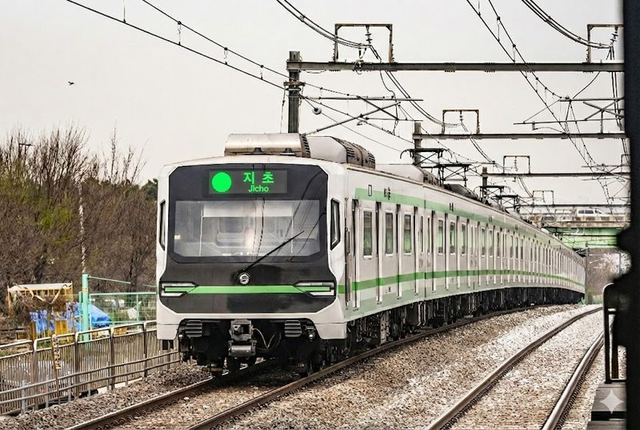
The line's trains are modelled on the Seoul Metro 3000 series (second generation, second batch) (Dawonsys) (see Transitica rolling stock).
History
Seoul Subway Line 3's VVVF-controlled 3000-series trains came in two batches. Hyundai Rotem built the first, 34 trains, in 2009–2010. The second batch, modelled here, was built by Dawonsys in 2021–2022: 150 cars making 15 ten-car trains, ordered to replace every remaining chopper-controlled 3000-series train, the old GEC-equipped trains of 1990–1993. The first of them, set 316, went into service in 2021; the rest were held back for months of test running because of brake faults, and in December 2023 a fire broke out in the heating and air-conditioning switchboard of set 347 while it was parked at Suseo depot. The trains are kept at Jichuk and Suseo depots, and a third batch is planned for around 2032.
Design and features
The second batch is a sister design of the Dawonsys-built Line 2 trains (the 2000 series' third and fifth batches): apart from the styling, the signalling and the radio equipment for platform screen doors, the specification is the same, and they sound alike too. The bodies are aluminium, the drive is Dawonsys's own IGBT inverter with AC induction motors, and the brakes combine regenerative and electrically commanded air braking. Seats are laid out 3-6-6-6-3 along each side. Namu Wiki notes the cars vibrate rather more than the first batch, even though they are newer.
Specifications
| Real-world train | |
|---|---|
| Manufacturer | Dawonsys |
| Built | 2021–2022 |
| Entered service | 2021 |
| Number built | 150 cars (15 ten-car trains) |
| Formation | 10 cars |
| Car body | aluminium |
| Car length | 19.95 m (end cars); 19.5 m (middle cars) |
| Width | 3.12 m (10 ft 3 in) |
| Height | 3.75 m (12 ft 4 in) |
| Doors | 4 pairs per side |
| Seating | bench seats, 3-6-6-6-3 per side |
| Maximum speed | 80 km/h (50 mph) in service; 100 km/h design |
| Traction | Dawonsys VVVF–IGBT, 3-phase AC induction motors (gear ratio 14:99) |
| Electric system | 1,500 V DC overhead line |
| Signalling | US&S (Hitachi Rail STS) ATC |
| Track gauge | 1,435 mm (4 ft 8½ in) |
In Transitica
Seogyeong Mass Rapid Transit took part in the same 2021 tender as Seoul Metro's Line 3 replacement trains, and its Titanium line order also went to Dawonsys. Its trains share the Seoul batch's brake problems and long test running before entering service.
How the line's trains are set up in the game:
- Cars: 3
- Car Length: 19.5 m
- Platform Length: 60 m
Source: 서울교통공사 3000호대 VVVF 전동차 on Namu Wiki (in Korean).