
Pi (π) line
| Pi (π) | |
|---|---|
| Line of the Transitica Railway Network | |
 | |
| Number | π |
| Type | Rapid transit |
| Color | #72CA5A |
| Operator | TBDC Railways |
| Division | TBDCR Division A (subway) |
| Rolling stock | WMATA (CAF) 5000 Series |
| Termini | Independence Square MIA Terminal 3 ✈ |
| Stations | 5 |
| Length | 7,874 blocks (7.9 km) |
| Dimension | minecraft/overworld |
The Pi (π) Line, numbered π, is a subway line part of TBDC Railways in the Transitica Railway Network. It runs between Independence Square and MIA Terminal 3 ✈, serving 5 stations over about 7.9 km.
Route
| Station | Connections | Platforms | km | |
|---|---|---|---|---|
| Independence Square |  | ▼4 ▲3 | 0.0 | |
| TBDC Union Station |   | ▼2 ▲1 | 0.5 | |
| Industry |  | ▼3 ▲2 | 2.0 | |
| MIA Terminal 2 ✈ |   | ▼1 ▲4 | 6.1 | |
| MIA Terminal 3 ✈ | | 2 | 7.9 |

History[edit]
The line was first planned as the TBDCR Pi Line (), a subway line of the TBDC Railways (TBDCR Division A (subway)) with 5 stations between MIA Terminal 3 and Independence Square.
Rolling stock[edit]
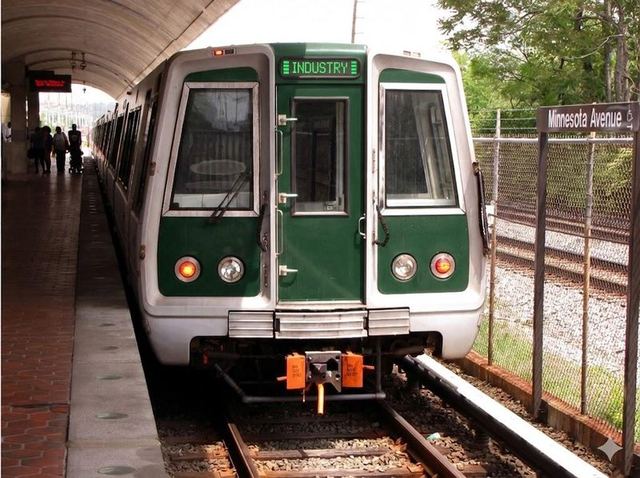
The line's trains are modelled on the WMATA (CAF) 5000 Series (see Transitica rolling stock).
History[edit]
The 5000-series was a fleet of 192 Washington Metro cars designed by CAF of Spain and assembled by AAI at Hunt Valley, Maryland, delivered from 2001. Software problems delayed their start in passenger service, and they became known as the least reliable cars Metro ran: on average a 7000-series car later went about five times as far between failures. A 5000-series train derailed at Mount Vernon Square on 7 January 2007, and the NTSB also investigated several yard derailments.
Metro decided in June 2015 to retire them early. Their last day in passenger service was 12 October 2018, and the last work cars went in spring 2019. They were replaced by the 7000-series.
Design and features[edit]
The 5000s were the first Metrorail cars with three-phase AC traction motors and IGBT inverters. They also introduced exterior LED destination signs, interior LED next-stop signs, barriers between cars to stop people falling between them, and on-board monitoring. Riders remembered them for their carpeted floors and red, white and blue interiors.
Specifications[edit]
| Real-world train | In Transitica | |
|---|---|---|
| Manufacturer | CAF (design); AAI (assembly, Hunt Valley, Maryland) | |
| Delivered | from 2001 | |
| Retired | 12 October 2018 | |
| Number built | 192 cars | |
| Formation | married pairs | |
| Cars per train | 2 | |
| Traction | IGBT–VVVF, AC motors | |
| Car length | 22.86 m (75 ft) | 22.86 m (75 ft) |
| Width | 3.09 m (10 ft 1.75 in) | |
| Doors | 3 per side | |
| Maximum speed | 121 km/h (75 mph) | |
| Electric system | 750 V DC third rail | |
| Track gauge | 1,429 mm (4 ft 8¼ in) | |
| Platform length | 60 m (197 ft) |
In Transitica[edit]
The Pi line's trains are CAF 5000-series cars, bought alongside WMATA's in 2001. Washington found them its least reliable cars and retired them in 2018, but TBDCR kept its small batch on the short Pi line, where it still runs two-car trains with carpeted floors.
Source: Washington Metro rolling stock on Wikipedia.