
Omicron (ο) line: Difference between revisions
| Revision as of 03:21, 24 November 2026 claude (Add the Transitica route-profile document (outdated) to the wiki) | Revision as of 20:55, 25 November 2026 claude (Rolling stock: in-game train settings merged into the specifications table (real world vs In Transitica)) | ||
|---|---|---|---|
| Line 1: | Line 1: | ||
| + | --- | ||
| + | infobox: | ||
| + | Operator: "[[TBDC Railways]]" | ||
| + | Division: "TBDCR Division A (subway)" | ||
| + | Rolling stock: "WMATA (Kawasaki) 7000 Series" | ||
| + | --- | ||
| + | {{route}} | ||
| + | |||
## History | ## History | ||
| − | In the [[Transitica]] plan, an older route-profile document for this world that is now out of date, this line was the '''TBDCR Omicron Line''' (<span class="chip" style="background:#b240a9;color:#fff;border-radius:.8em;min-width:1.6em">ο</span>), a subway line of the [[TBDC Railways]] with 5 stations between Duckville and TBDC Aquatics. Its ideal rolling stock was the WMATA (Kawasaki) 7000 Series (2 cars). | + | The line was first planned as the '''TBDCR Omicron Line''' (<img class="chip-img" src="/images/bullet-omicron.png" alt="ο" loading="lazy">), a subway line of the [[TBDC Railways]] (TBDCR Division A (subway)) with 5 stations between Duckville and TBDC Aquatics. |
| − | The full old route profile is at [[Omicron line (Transitica)]]. | + | ## Rolling stock |
| + | |||
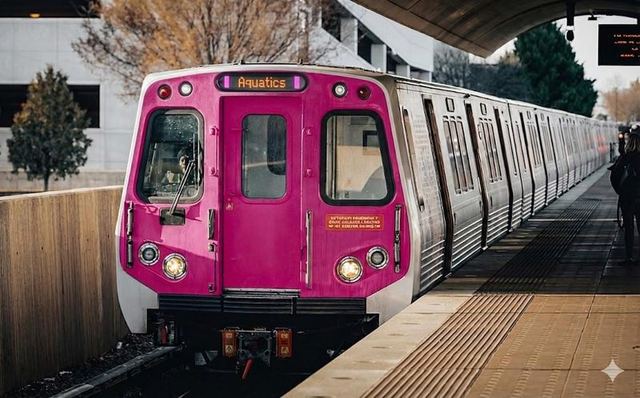
| + | The line's trains are modelled on the '''WMATA (Kawasaki) 7000 Series''' (see [[Transitica rolling stock]]). | ||
| + | |||
| + |  | ||
| + | |||
| + | ### History | ||
| + | |||
| + | The 7000-series is the Washington Metro's largest and newest fleet, built by Kawasaki (with final assembly in Lincoln, Nebraska) to replace the original 1000-series cars, which proved too weak in the deadly 2009 Fort Totten crash, and the troubled 5000-series. The first cars arrived in January 2014, and they entered service on the Blue Line on 14 April 2015 and the Red Line that June. All 748 cars were delivered by February 2020. | ||
| + | |||
| + | The 7000s were pulled from the Blue, Orange and Silver lines in 2016 after touching the third rail on a sharp curve. On 12 October 2021 a Blue Line train derailed near Arlington Cemetery because its wheels had moved out along the axles, and the whole fleet was taken out of service on 18 October; inspections found 20 bad axles. The cars returned gradually from December 2021, normal service resumed by February 2023, and the axles are being fixed over several years. | ||
| + | |||
| + | ### Design and features | ||
| + | |||
| + | The cars are much stronger in a crash than earlier Metro cars, with stainless-steel bodies instead of aluminium. They were also the first Metro cars without carpet, with resilient floors, LCD screens and active route maps, automated announcements, and security cameras. They run as A–B pairs in which only the A car has a full cab, so they are formed into four-car units and four-, six- or eight-car trains, and they cannot be coupled to older Metro cars. | ||
| + | |||
| + | ### Specifications | ||
| + | |||
| + | <table class="wikitable rs-specs rs-compare"><tr><th></th><th>Real-world train</th><th>In Transitica</th></tr><tr><th>Manufacturer</th><td>Kawasaki (Lincoln, Nebraska)</td><td></td></tr><tr><th>Built</th><td>2013–2020</td><td></td></tr><tr><th>Entered service</th><td>14 April 2015</td><td></td></tr><tr><th>Number built</th><td>748 cars</td><td></td></tr><tr><th>Formation</th><td>A–B pairs (cab only in the A car), run as 4, 6 or 8 cars</td><td></td></tr><tr><th>Cars per train</th><td></td><td>2</td></tr><tr><th>Car body</th><td>stainless steel</td><td></td></tr><tr><th>Traction</th><td>IGBT–VVVF, AC motors</td><td></td></tr><tr><th>Car length</th><td>22.86 m (75 ft)</td><td>22.86 m (75 ft)</td></tr><tr><th>Width</th><td>3.09 m (10 ft 1.75 in)</td><td></td></tr><tr><th>Doors</th><td>3 per side</td><td></td></tr><tr><th>Maximum speed</th><td>121 km/h (75 mph)</td><td></td></tr><tr><th>Electric system</th><td>750 V DC third rail</td><td></td></tr><tr><th>Track gauge</th><td>1,429 mm (4 ft 8¼ in)</td><td></td></tr><tr><th>Platform length</th><td></td><td>60 m (197 ft)</td></tr></table> | ||
| + | |||
| + | ### In Transitica | ||
| + | |||
| + | TBDC Railways' Division A is built to Washington Metro standards, and in 2010 TBDCR joined WMATA's 7000-series order with Kawasaki for the Omicron line. Its cars were assembled in Lincoln, Nebraska, and in October 2021, after the Blue Line derailment in Washington, TBDCR also took every 7000-series car out of service to check the axles. | ||
| + | |||
| + | <p class="rs-source">Source: <a href="https://en.wikipedia.org/wiki/Washington_Metro_rolling_stock" rel="noopener">Washington Metro rolling stock</a> on Wikipedia.</p> | ||
Revision as of 20:55, 25 November 2026
| Omicron (ο) | |
|---|---|
| Line of the Transitica Railway Network | |
 | |
| Number | ο |
| Type | Rapid transit |
| Color | #B240A9 |
| Operator | TBDC Railways |
| Division | TBDCR Division A (subway) |
| Rolling stock | WMATA (Kawasaki) 7000 Series |
| Termini | Duckville Aquatics |
| Stations | 5 |
| Length | 2,448 blocks (2.4 km) |
| Dimension | minecraft/overworld |
The Omicron (ο) Line, numbered ο, is a subway line part of TBDC Railways in the Transitica Railway Network. It runs between Duckville and Aquatics, serving 5 stations over about 2.4 km.
Route
| Station | Connections | Platforms | km | |
|---|---|---|---|---|
| Duckville | ▼1 ▲2 | 0.0 | ||
| Duck Boulevard | ▼1 ▲2 | 0.4 | ||
| Duck Parkway | ▼1 ▲2 | 1.0 | ||
| Bayside | ▼1 ▲2 | 1.6 | ||
| Aquatics |  | ▼1 ▲2 | 2.4 |



History
The line was first planned as the TBDCR Omicron Line (), a subway line of the TBDC Railways (TBDCR Division A (subway)) with 5 stations between Duckville and TBDC Aquatics.
Rolling stock
The line's trains are modelled on the WMATA (Kawasaki) 7000 Series (see Transitica rolling stock).

History
The 7000-series is the Washington Metro's largest and newest fleet, built by Kawasaki (with final assembly in Lincoln, Nebraska) to replace the original 1000-series cars, which proved too weak in the deadly 2009 Fort Totten crash, and the troubled 5000-series. The first cars arrived in January 2014, and they entered service on the Blue Line on 14 April 2015 and the Red Line that June. All 748 cars were delivered by February 2020.
The 7000s were pulled from the Blue, Orange and Silver lines in 2016 after touching the third rail on a sharp curve. On 12 October 2021 a Blue Line train derailed near Arlington Cemetery because its wheels had moved out along the axles, and the whole fleet was taken out of service on 18 October; inspections found 20 bad axles. The cars returned gradually from December 2021, normal service resumed by February 2023, and the axles are being fixed over several years.
Design and features
The cars are much stronger in a crash than earlier Metro cars, with stainless-steel bodies instead of aluminium. They were also the first Metro cars without carpet, with resilient floors, LCD screens and active route maps, automated announcements, and security cameras. They run as A–B pairs in which only the A car has a full cab, so they are formed into four-car units and four-, six- or eight-car trains, and they cannot be coupled to older Metro cars.
Specifications
| Real-world train | In Transitica | |
|---|---|---|
| Manufacturer | Kawasaki (Lincoln, Nebraska) | |
| Built | 2013–2020 | |
| Entered service | 14 April 2015 | |
| Number built | 748 cars | |
| Formation | A–B pairs (cab only in the A car), run as 4, 6 or 8 cars | |
| Cars per train | 2 | |
| Car body | stainless steel | |
| Traction | IGBT–VVVF, AC motors | |
| Car length | 22.86 m (75 ft) | 22.86 m (75 ft) |
| Width | 3.09 m (10 ft 1.75 in) | |
| Doors | 3 per side | |
| Maximum speed | 121 km/h (75 mph) | |
| Electric system | 750 V DC third rail | |
| Track gauge | 1,429 mm (4 ft 8¼ in) | |
| Platform length | 60 m (197 ft) |
In Transitica
TBDC Railways' Division A is built to Washington Metro standards, and in 2010 TBDCR joined WMATA's 7000-series order with Kawasaki for the Omicron line. Its cars were assembled in Lincoln, Nebraska, and in October 2021, after the Blue Line derailment in Washington, TBDCR also took every 7000-series car out of service to check the axles.
Source: Washington Metro rolling stock on Wikipedia.