
Omicron (ο) line: Difference between revisions
| Revision as of 07:35, 25 November 2026 claude (Track layouts per level with real platform sides and switches; fare-zone overlay; drop route profiles) | Revision as of 20:19, 25 November 2026 claude (Rolling stock: full history, design and real-world specifications for every line's train, from Wikipedia) | ||
|---|---|---|---|
| Line 19: | Line 19: | ||
| − | The 7000 series are Washington Metro cars built by Kawasaki from 2014. They run in married pairs, are much stronger in a crash than earlier cars, and have digital information screens, automated announcements, security cameras and LED lighting. They are the most numerous cars in the fleet. | + | ### History |
| − | In Transitica: | + | The 7000-series is the Washington Metro's largest and newest fleet, built by Kawasaki (with final assembly in Lincoln, Nebraska) to replace the original 1000-series cars, which proved too weak in the deadly 2009 Fort Totten crash, and the troubled 5000-series. The first cars arrived in January 2014, and they entered service on the Blue Line on 14 April 2015 and the Red Line that June. All 748 cars were delivered by February 2020. |
| + | The 7000s were pulled from the Blue, Orange and Silver lines in 2016 after touching the third rail on a sharp curve. On 12 October 2021 a Blue Line train derailed near Arlington Cemetery because its wheels had moved out along the axles, and the whole fleet was taken out of service on 18 October; inspections found 20 bad axles. The cars returned gradually from December 2021, normal service resumed by February 2023, and the axles are being fixed over several years. | ||
| + | |||
| + | ### Design and features | ||
| + | |||
| + | The cars are much stronger in a crash than earlier Metro cars, with stainless-steel bodies instead of aluminium. They were also the first Metro cars without carpet, with resilient floors, LCD screens and active route maps, automated announcements, and security cameras. They run as A–B pairs in which only the A car has a full cab, so they are formed into four-car units and four-, six- or eight-car trains, and they cannot be coupled to older Metro cars. | ||
| + | |||
| + | ### Specifications | ||
| + | |||
| + | <table class="wikitable rs-specs"><tr><th colspan="2">Real-world train</th></tr><tr><th>Manufacturer</th><td>Kawasaki (Lincoln, Nebraska)</td></tr><tr><th>Built</th><td>2013–2020</td></tr><tr><th>Entered service</th><td>14 April 2015</td></tr><tr><th>Number built</th><td>748 cars</td></tr><tr><th>Formation</th><td>A–B pairs (cab only in the A car), run as 4, 6 or 8 cars</td></tr><tr><th>Car body</th><td>stainless steel</td></tr><tr><th>Traction</th><td>IGBT–VVVF, AC motors</td></tr><tr><th>Car length</th><td>22.86 m (75 ft)</td></tr><tr><th>Width</th><td>3.09 m (10 ft 1.75 in)</td></tr><tr><th>Doors</th><td>3 per side</td></tr><tr><th>Maximum speed</th><td>121 km/h (75 mph)</td></tr><tr><th>Electric system</th><td>750 V DC third rail</td></tr><tr><th>Track gauge</th><td>1,429 mm (4 ft 8¼ in)</td></tr></table> | ||
| + | |||
| + | ### In Transitica | ||
| + | |||
| + | How the line's trains are set up in the game: | ||
| + | |||
- Cars: 2 | - Cars: 2 | ||
- Car Length: 22.86 m (75 ft) | - Car Length: 22.86 m (75 ft) | ||
- Platform Length: 60 m (197 ft) | - Platform Length: 60 m (197 ft) | ||
| + | |||
| + | <p class="rs-source">Source: <a href="https://en.wikipedia.org/wiki/Washington_Metro_rolling_stock" rel="noopener">Washington Metro rolling stock</a> on Wikipedia.</p> | ||
Revision as of 20:19, 25 November 2026
| Omicron (ο) | |
|---|---|
| Line of the Transitica Railway Network | |
 | |
| Number | ο |
| Type | Rapid transit |
| Color | #B240A9 |
| Operator | TBDC Railways |
| Division | TBDCR Division A (subway) |
| Rolling stock | WMATA (Kawasaki) 7000 Series |
| Termini | Duckville Aquatics |
| Stations | 5 |
| Length | 2,448 blocks (2.4 km) |
| Dimension | minecraft/overworld |
The Omicron (ο) Line, numbered ο, is a subway line part of TBDC Railways in the Transitica Railway Network. It runs between Duckville and Aquatics, serving 5 stations over about 2.4 km.
Route
| Station | Connections | Platforms | km | |
|---|---|---|---|---|
| Duckville | ▼1 ▲2 | 0.0 | ||
| Duck Boulevard | ▼1 ▲2 | 0.4 | ||
| Duck Parkway | ▼1 ▲2 | 1.0 | ||
| Bayside | ▼1 ▲2 | 1.6 | ||
| Aquatics |  | ▼1 ▲2 | 2.4 |



History
The line was first planned as the TBDCR Omicron Line (), a subway line of the TBDC Railways (TBDCR Division A (subway)) with 5 stations between Duckville and TBDC Aquatics.
Rolling stock
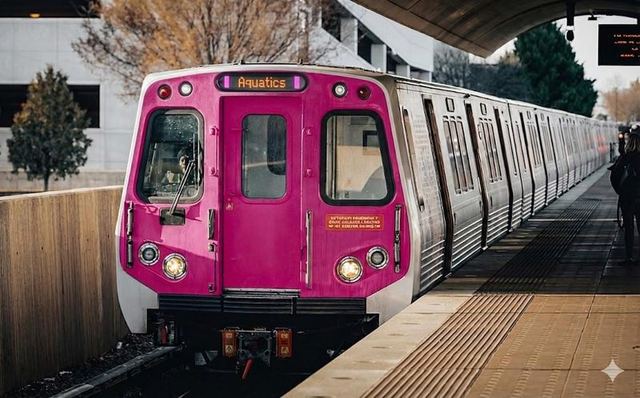
The line's trains are modelled on the WMATA (Kawasaki) 7000 Series (see Transitica rolling stock).
History
The 7000-series is the Washington Metro's largest and newest fleet, built by Kawasaki (with final assembly in Lincoln, Nebraska) to replace the original 1000-series cars, which proved too weak in the deadly 2009 Fort Totten crash, and the troubled 5000-series. The first cars arrived in January 2014, and they entered service on the Blue Line on 14 April 2015 and the Red Line that June. All 748 cars were delivered by February 2020.
The 7000s were pulled from the Blue, Orange and Silver lines in 2016 after touching the third rail on a sharp curve. On 12 October 2021 a Blue Line train derailed near Arlington Cemetery because its wheels had moved out along the axles, and the whole fleet was taken out of service on 18 October; inspections found 20 bad axles. The cars returned gradually from December 2021, normal service resumed by February 2023, and the axles are being fixed over several years.
Design and features
The cars are much stronger in a crash than earlier Metro cars, with stainless-steel bodies instead of aluminium. They were also the first Metro cars without carpet, with resilient floors, LCD screens and active route maps, automated announcements, and security cameras. They run as A–B pairs in which only the A car has a full cab, so they are formed into four-car units and four-, six- or eight-car trains, and they cannot be coupled to older Metro cars.
Specifications
| Real-world train | |
|---|---|
| Manufacturer | Kawasaki (Lincoln, Nebraska) |
| Built | 2013–2020 |
| Entered service | 14 April 2015 |
| Number built | 748 cars |
| Formation | A–B pairs (cab only in the A car), run as 4, 6 or 8 cars |
| Car body | stainless steel |
| Traction | IGBT–VVVF, AC motors |
| Car length | 22.86 m (75 ft) |
| Width | 3.09 m (10 ft 1.75 in) |
| Doors | 3 per side |
| Maximum speed | 121 km/h (75 mph) |
| Electric system | 750 V DC third rail |
| Track gauge | 1,429 mm (4 ft 8¼ in) |
In Transitica
How the line's trains are set up in the game:
- Cars: 2
- Car Length: 22.86 m (75 ft)
- Platform Length: 60 m (197 ft)
Source: Washington Metro rolling stock on Wikipedia.