
Mu (μ) line: Difference between revisions
| Revision as of 22:57, 24 November 2026 claude (Route profiles merged into line pages; agency, yard, express/local, interlining, world and airport pages) | Revision as of 20:55, 25 November 2026 claude (Rolling stock: in-game train settings merged into the specifications table (real world vs In Transitica)) | ||
|---|---|---|---|
| Line 5: | Line 5: | ||
| − | Yard (route profile): "Mineopolis Central Lower" | + | Rolling stock: "E231-0 Series" |
| − | Ideal rolling stock: "E231-0 Series" | ||
--- | --- | ||
{{route}} | {{route}} | ||
| Line 10: | Line 9: | ||
## History | ## History | ||
| − | In the [[Transitica route profiles]], an older planning document, this line was the '''MINEOT Mu Line''' (<img class="chip-img" src="/images/bullet-mu.png" alt="μ" loading="lazy">), a commuter rail line of the [[Mineopolis Transport]] (MINEOT Overground (commuter rail)) with 9 stations between Ravenstone and Farncombe 🚆. | + | The line was first planned as the '''MINEOT Mu Line''' (<img class="chip-img" src="/images/bullet-mu.png" alt="μ" loading="lazy">), a commuter rail line of the [[Mineopolis Transport]] (MINEOT Overground (commuter rail)) with 9 stations between Ravenstone and Farncombe 🚆. |
| − | ## Route profile | + | ## Rolling stock |
| − | The route profile still matches the line today: the same 9 stations, between the same termini. | + | The line's trains are modelled on the '''E231-0 Series''' (see [[Transitica rolling stock]]). |
| − | ### Operations in the route profile | + | 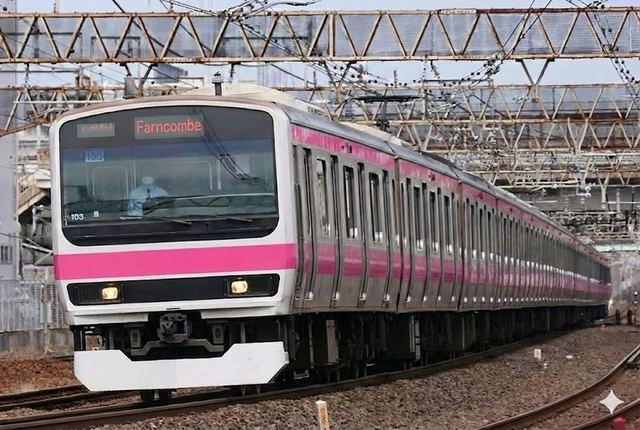 |
| − | - '''Yard:''' Mineopolis Central Lower (see [[Yards and depots]]). | + | ### History |
| − | ## Ideal rolling stock | + | The E231 series was JR East's standard commuter and suburban train of the 2000s, developed from the 209 and E217 series and built by Tokyu Car, Kawasaki and JR East's Niitsu factory. It first carried passengers on 13 March 2000, replaced the 103, 113, 115, 201, 205 and 301 series, and has since been followed by the E235. |
| − | The route profile chose this real-world train for the line (see [[Transitica rolling stock]]): | + | The E231-0 subseries was the first production version, entering service on the Chūō–Sōbu local line between February 2000 and November 2001; more sets went to the Jōban and Narita lines up to 2005. The Chūō–Sōbu sets each had a six-door car and were refurbished between 2015 and 2020, after which many were shortened to eight cars for the Musashino Line or four cars as the E231-3000. |
| − | ### E231-0 Series | + | ### Design and features |
| − |  | + | The E231 is wider than earlier JR commuter trains (2.95 m against 2.8 m), with stainless-steel bodies, IGBT–VVVF control and regenerative braking. It runs on 1,500 V DC overhead lines and has four pairs of doors per side; some early cars had six pairs to speed up boarding in the rush hour. |
| − | - Cars: 6 | + | ### Specifications |
| − | - Car Length: 20 m (65.6 ft) | ||
| − | - Platform Length: 121 m (397 ft) | ||
| + | <table class="wikitable rs-specs rs-compare"><tr><th></th><th>Real-world train</th><th>In Transitica</th></tr><tr><th>Manufacturer</th><td>Kawasaki, Tokyu Car, JR East Niitsu</td><td></td></tr><tr><th>Entered service</th><td>2000</td><td></td></tr><tr><th>Formation</th><td>10-car, 10+5-car, 8-car and 4-car sets</td><td></td></tr><tr><th>Cars per train</th><td></td><td>6</td></tr><tr><th>Lines (real world)</th><td>Chūō–Sōbu, Jōban, Narita and Musashino lines</td><td></td></tr><tr><th>Width</th><td>2.95 m (9 ft 8 in)</td><td></td></tr><tr><th>Doors</th><td>4 pairs per side</td><td></td></tr><tr><th>Car body</th><td>stainless steel</td><td></td></tr><tr><th>Car length</th><td>20 m (65 ft 7 in)</td><td>20 m (65.6 ft)</td></tr><tr><th>Maximum speed</th><td>120 km/h (75 mph)</td><td></td></tr><tr><th>Traction</th><td>IGBT–VVVF</td><td></td></tr><tr><th>Electric system</th><td>1,500 V DC overhead line</td><td></td></tr><tr><th>Track gauge</th><td>1,067 mm (3 ft 6 in)</td><td></td></tr><tr><th>Platform length</th><td></td><td>121 m (397 ft)</td></tr></table> | ||
| + | |||
| + | ### In Transitica | ||
| + | |||
| + | When JR East refurbished its Chūō–Sōbu E231-0 sets between 2015 and 2020 and removed their six-door cars, MINEOT bought the surplus sets for the Mu line. They arrived as six-car trains still carrying the yellow Chūō–Sōbu stripe, which MINEOT repainted in the Mu line's colour. | ||
| + | |||
| + | <p class="rs-source">Source: <a href="https://en.wikipedia.org/wiki/E231_series" rel="noopener">E231 series</a> on Wikipedia.</p> | ||
Revision as of 20:55, 25 November 2026
| Mu (μ) | |
|---|---|
| Line of the Transitica Railway Network | |
 | |
| Number | μ |
| Type | High-speed rail |
| Color | #FE7CE2 |
| Operator | Mineopolis Transport |
| Division | MINEOT Overground (commuter rail) |
| Rolling stock | E231-0 Series |
| Termini | Farncombe Ravenstone |
| Stations | 9 |
| Length | 14,008 blocks (14.0 km) |
| Dimension | minecraft/overworld |
The Mu (μ) Line, numbered μ, is a commuter rail line part of Mineopolis Transport in the Transitica Railway Network. It runs between Farncombe and Ravenstone, serving 9 stations over about 14.0 km.
Route
| Station | Connections | Platforms | km | |
|---|---|---|---|---|
| Farncombe |     | 5 | 0.0 | |
| Burgress Plains | ▼2 ▲1 | 1.7 | ||
| Mineopolis Grand Central |        | ▼D ▲B | 2.7 | |
| Fayre Place | | ▼3 ▲4 | 4.0 | |
| Hailgate Interchange | | ▼4 ▲3 | 7.5 | |
| MIA Terminal 1 ✈ | | ▼3 ▲2 | 9.9 | |
| Atomster | ▼2 ▲1 | 12.0 | ||
| Ravenstone International | | ▼4 ▲3 | 12.7 | |
| Ravenstone | ▼2 ▲1 | 14.0 |
History
The line was first planned as the MINEOT Mu Line (), a commuter rail line of the Mineopolis Transport (MINEOT Overground (commuter rail)) with 9 stations between Ravenstone and Farncombe 🚆.
Rolling stock
The line's trains are modelled on the E231-0 Series (see Transitica rolling stock).

History
The E231 series was JR East's standard commuter and suburban train of the 2000s, developed from the 209 and E217 series and built by Tokyu Car, Kawasaki and JR East's Niitsu factory. It first carried passengers on 13 March 2000, replaced the 103, 113, 115, 201, 205 and 301 series, and has since been followed by the E235.
The E231-0 subseries was the first production version, entering service on the Chūō–Sōbu local line between February 2000 and November 2001; more sets went to the Jōban and Narita lines up to 2005. The Chūō–Sōbu sets each had a six-door car and were refurbished between 2015 and 2020, after which many were shortened to eight cars for the Musashino Line or four cars as the E231-3000.
Design and features
The E231 is wider than earlier JR commuter trains (2.95 m against 2.8 m), with stainless-steel bodies, IGBT–VVVF control and regenerative braking. It runs on 1,500 V DC overhead lines and has four pairs of doors per side; some early cars had six pairs to speed up boarding in the rush hour.
Specifications
| Real-world train | In Transitica | |
|---|---|---|
| Manufacturer | Kawasaki, Tokyu Car, JR East Niitsu | |
| Entered service | 2000 | |
| Formation | 10-car, 10+5-car, 8-car and 4-car sets | |
| Cars per train | 6 | |
| Lines (real world) | Chūō–Sōbu, Jōban, Narita and Musashino lines | |
| Width | 2.95 m (9 ft 8 in) | |
| Doors | 4 pairs per side | |
| Car body | stainless steel | |
| Car length | 20 m (65 ft 7 in) | 20 m (65.6 ft) |
| Maximum speed | 120 km/h (75 mph) | |
| Traction | IGBT–VVVF | |
| Electric system | 1,500 V DC overhead line | |
| Track gauge | 1,067 mm (3 ft 6 in) | |
| Platform length | 121 m (397 ft) |
In Transitica
When JR East refurbished its Chūō–Sōbu E231-0 sets between 2015 and 2020 and removed their six-door cars, MINEOT bought the surplus sets for the Mu line. They arrived as six-car trains still carrying the yellow Chūō–Sōbu stripe, which MINEOT repainted in the Mu line's colour.
Source: E231 series on Wikipedia.