
Magnesium (MG) line: Difference between revisions
| Revision as of 07:35, 25 November 2026 claude (Track layouts per level with real platform sides and switches; fare-zone overlay; drop route profiles) | Revision as of 20:55, 25 November 2026 claude (Rolling stock: in-game train settings merged into the specifications table (real world vs In Transitica)) | ||
|---|---|---|---|
| Line 5: | Line 5: | ||
| − | Rolling stock: "JR East (JR East Niitsu, Kawasaki, Tokyu Car, J-TREC) E223-0 Series" | + | Rolling stock: "JR East (JR East Niitsu, Kawasaki, Tokyu Car, J-TREC) E233-0 Series" |
--- | --- | ||
{{route}} | {{route}} | ||
| Line 15: | Line 15: | ||
## Rolling stock | ## Rolling stock | ||
| − | The line's trains are modelled on the '''JR East (JR East Niitsu, Kawasaki, Tokyu Car, J-TREC) E223-0 Series''' (see [[Transitica rolling stock]]). | + | The line's trains are modelled on the '''JR East (JR East Niitsu, Kawasaki, Tokyu Car, J-TREC) E233-0 Series''' (see [[Transitica rolling stock]]). |
| − |  | + |  |
| − | This is a JR East commuter electric multiple unit of the E200-series family, with VVVF inverter control and LCD information screens above the doors. | + | ### History |
| − | In Transitica: | + | The E233 series is JR East's main commuter and suburban train, developed from the E231 and E531 and built by JR East's own Niitsu factory, Kawasaki, Tokyu Car and J-TREC. The first trains entered service on the Chūō Rapid Line on 26 December 2006, and more than 3,000 cars were running by 2020, replacing the 201, 203, 205, 209, 211 and E331 series on lines all around Tokyo. |
| − | - Cars: 7 | + | The E233-0 subseries was the first E233 built, for the Chūō Rapid Line from Tokyo to Takao and the Ōme and Itsukaichi lines, where it replaced the orange 201 series. It entered service on 26 December 2006, and 688 cars were delivered by March 2008 as ten-car, six-car and four-car sets. From 2022 many sets have had two Green (first class) cars with toilets added. |
| − | - Car Length: 20 m (65.6 ft) | + | |
| − | - Platform Length: 138 m (452.8 ft) | + | ### Design and features |
| + | |||
| + | The E233 was JR East's first train built with its key equipment doubled up (such as the inverters and air compressors), so a single fault does not stop the train. It also lowered the step from the platform from 80 mm to 30 mm, widened the seats, lowered the hand straps and added air filters, and it was the first JR East train with full-colour LED destination signs. Inside, LCD screens above the doors show the next stops and service information. | ||
| + | |||
| + | ### Specifications | ||
| + | |||
| + | <table class="wikitable rs-specs rs-compare"><tr><th></th><th>Real-world train</th><th>In Transitica</th></tr><tr><th>Manufacturer</th><td>JR East Niitsu, Kawasaki, Tokyu Car, J-TREC</td><td></td></tr><tr><th>Entered service</th><td>26 December 2006</td><td></td></tr><tr><th>Number built</th><td>688 cars (ten-, six- and four-car sets)</td><td></td></tr><tr><th>Lines (real world)</th><td>Chūō Rapid, Ōme and Itsukaichi lines</td><td></td></tr><tr><th>Car body</th><td>stainless steel</td><td></td></tr><tr><th>Car length</th><td>20 m (65 ft 7 in)</td><td>20 m (65.6 ft)</td></tr><tr><th>Width</th><td>2.95 m (9 ft 8 in)</td><td></td></tr><tr><th>Doors</th><td>4 pairs per side</td><td></td></tr><tr><th>Maximum speed</th><td>120 km/h (75 mph)</td><td></td></tr><tr><th>Traction</th><td>IGBT–VVVF (Mitsubishi or Hitachi), MT75 AC motors</td><td></td></tr><tr><th>Electric system</th><td>1,500 V DC overhead line</td><td></td></tr><tr><th>Track gauge</th><td>1,067 mm (3 ft 6 in)</td><td></td></tr><tr><th>Cars per train</th><td></td><td>7</td></tr><tr><th>Platform length</th><td></td><td>138 m (452.8 ft)</td></tr></table> | ||
| + | |||
| + | ### In Transitica | ||
| + | |||
| + | The Magnesium line's trains were part of the very first E233 batch: when JR East ordered the E233-0 for the Chūō Rapid Line in 2006, 19CT added seven-car sets to the order. They entered service a few months after Tokyo's, replacing 19CT's own orange 201-series trains. | ||
| + | |||
| + | <p class="rs-source">Source: <a href="https://en.wikipedia.org/wiki/E233_series" rel="noopener">E233 series</a> on Wikipedia.</p> | ||
Revision as of 20:55, 25 November 2026
| Magnesium (MG) | |
|---|---|
| Line of the Transitica Railway Network | |
 | |
| Number | MG |
| Type | High-speed rail |
| Color | #EF9565 |
| Operator | XIXth Century City Transit |
| Division | 19CT Sub-Surface Lines (commuter rail) |
| Rolling stock | JR East (JR East Niitsu, Kawasaki, Tokyu Car, J-TREC) E233-0 Series |
| Termini | Anhalter Bahnhof Berlin - Friedenau |
| Stations | 3 |
| Length | 1,480 blocks (1.5 km) |
| Dimension | minecraft/overworld |
The Magnesium (MG) Line, numbered MG, is a commuter rail line part of XIXth Century City Transit in the Transitica Railway Network. It runs between Anhalter Bahnhof and Berlin - Friedenau, serving 3 stations over about 1.5 km.
Route
| Station | Connections | Platforms | km | |
|---|---|---|---|---|
| Anhalter Bahnhof |   | 1 | 0.0 | |
| Alexanderplatz |  | ▼1b ▲1a | 0.9 | |
| Berlin - Friedenau | 2 | 1.5 |
History
The line was first planned as the 19CT Magnesium Line (), a commuter rail line of the XIXth Century City Transit (19CT Sub-Surface Lines (commuter rail)) with 3 stations between Anhalter Bahnhof 🚆 and Berlin - Friedenau.
Anhalter Bahnhof has since been renamed Anhalter Bahnof.
Rolling stock
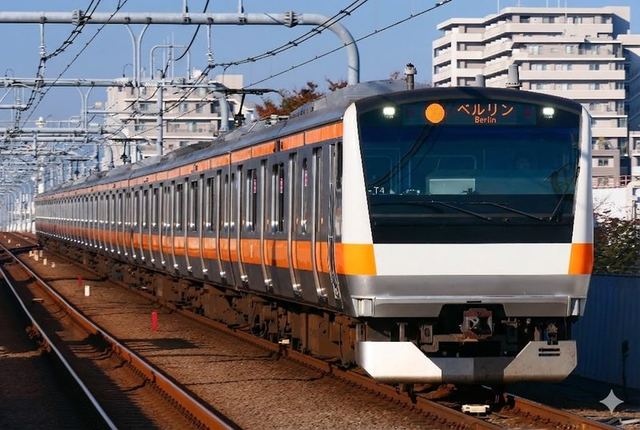
The line's trains are modelled on the JR East (JR East Niitsu, Kawasaki, Tokyu Car, J-TREC) E233-0 Series (see Transitica rolling stock).

History
The E233 series is JR East's main commuter and suburban train, developed from the E231 and E531 and built by JR East's own Niitsu factory, Kawasaki, Tokyu Car and J-TREC. The first trains entered service on the Chūō Rapid Line on 26 December 2006, and more than 3,000 cars were running by 2020, replacing the 201, 203, 205, 209, 211 and E331 series on lines all around Tokyo.
The E233-0 subseries was the first E233 built, for the Chūō Rapid Line from Tokyo to Takao and the Ōme and Itsukaichi lines, where it replaced the orange 201 series. It entered service on 26 December 2006, and 688 cars were delivered by March 2008 as ten-car, six-car and four-car sets. From 2022 many sets have had two Green (first class) cars with toilets added.
Design and features
The E233 was JR East's first train built with its key equipment doubled up (such as the inverters and air compressors), so a single fault does not stop the train. It also lowered the step from the platform from 80 mm to 30 mm, widened the seats, lowered the hand straps and added air filters, and it was the first JR East train with full-colour LED destination signs. Inside, LCD screens above the doors show the next stops and service information.
Specifications
| Real-world train | In Transitica | |
|---|---|---|
| Manufacturer | JR East Niitsu, Kawasaki, Tokyu Car, J-TREC | |
| Entered service | 26 December 2006 | |
| Number built | 688 cars (ten-, six- and four-car sets) | |
| Lines (real world) | Chūō Rapid, Ōme and Itsukaichi lines | |
| Car body | stainless steel | |
| Car length | 20 m (65 ft 7 in) | 20 m (65.6 ft) |
| Width | 2.95 m (9 ft 8 in) | |
| Doors | 4 pairs per side | |
| Maximum speed | 120 km/h (75 mph) | |
| Traction | IGBT–VVVF (Mitsubishi or Hitachi), MT75 AC motors | |
| Electric system | 1,500 V DC overhead line | |
| Track gauge | 1,067 mm (3 ft 6 in) | |
| Cars per train | 7 | |
| Platform length | 138 m (452.8 ft) |
In Transitica
The Magnesium line's trains were part of the very first E233 batch: when JR East ordered the E233-0 for the Chūō Rapid Line in 2006, 19CT added seven-car sets to the order. They entered service a few months after Tokyo's, replacing 19CT's own orange 201-series trains.
Source: E233 series on Wikipedia.