
Lithium (LI) line: Difference between revisions
| Revision as of 20:19, 25 November 2026 claude (Rolling stock: full history, design and real-world specifications for every line's train, from Wikipedia) | Revision as of 20:26, 25 November 2026 claude (Rolling stock: in-world history of how each line's agency got its trains, tied to the real orders) | ||
|---|---|---|---|
| Line 37: | Line 37: | ||
| + | The MBTA wanted three doors per side on the Lithium line to suit platform screen doors, so it ordered JR West's 323 series, built by Kawasaki and Kinki Sharyo for the Osaka Loop Line, and runs them as long fifteen-car trains. | ||
| + | |||
Revision as of 20:26, 25 November 2026
| Lithium (LI) | |
|---|---|
| Line of the Transitica Railway Network | |
 | |
| Number | LI |
| Type | High-speed rail |
| Color | #6EFF3C |
| Operator | Massachusetts Bay Transit Authority |
| Division | MBTA Conventional Rail (commuter rail) |
| Rolling stock | JR West (Kawasaki) 323 Series |
| Termini | Back Bay West Forest Hills West |
| Stations | 3 |
| Length | 6,021 blocks (6.0 km) |
| Dimension | minecraft/overworld |
The Lithium (LI) Line, numbered LI, is a commuter rail line part of the Massachusetts Bay Transit Authority in the Transitica Railway Network. It runs between Back Bay West and Forest Hills West, serving 3 stations over about 6.0 km.
Route
| Station | Connections | Platforms | km | |
|---|---|---|---|---|
| Back Bay West |   | ▼3 ▲4 | 0.0 | |
| Ruggles West | | ▼3 ▲4 | 1.6 | |
| Roxbury Crossing | ||||
| Jackson Square | ||||
| Stony Brook | ||||
| Green Street | ||||
| Forest Hills West | | 3 | 6.0 | |
History
The line was first planned as the MBTA Lithium Line (), a commuter rail line of the Massachusetts Bay Transit Authority (MBTA Conventional Rail (commuter rail)) with 3 stations between Back Bay West🚆 and Forest Hills West.
Operations
- Oak Grove – Forest Hills West corridor: runs express, skipping Roxbury Crossing, Jackson Square, Stony Brook and Green Street; shares the corridor with Helium (HE) line (express), Hydrogen (HY) line (local) (see Express and local sections).
Rolling stock
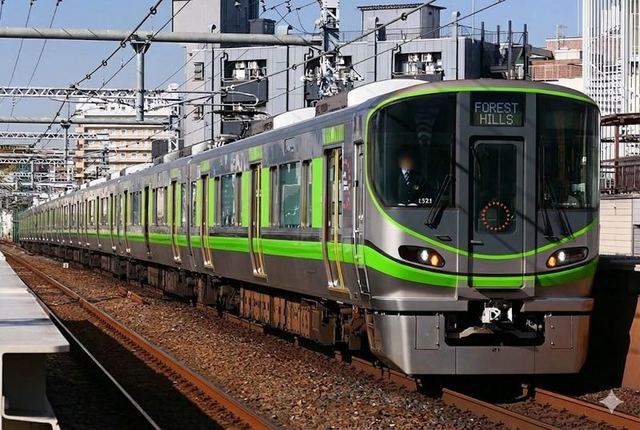
The line's trains are modelled on the JR West (Kawasaki) 323 Series (see Transitica rolling stock).
History
The 323 series is JR West's train for the Osaka Loop Line, the circular line around central Osaka, and the Sakurajima Line to Universal Studios Japan. Kawasaki and Kinki Sharyo built 22 eight-car sets (176 cars) between 2016 and 2019. The first entered service on 24 December 2016, and they replaced the orange 103 and 201 series that had worked the loop for decades.
Design and features
The 323 series has three pairs of wide doors per side instead of the four on older commuter trains, so the doors line up with the platform screen doors JR West is installing, and in time with other JR West trains. All eight cars are powered, using silicon-carbide MOSFET drives. The bodies are stainless steel with orange bands, the loop line's colour, and inside there is LED lighting, Wi-Fi, information screens in four languages and a women-only car.
Specifications
| Real-world train | |
|---|---|
| Manufacturer | Kawasaki, Kinki Sharyo |
| Built | 2016–2019 |
| Entered service | 24 December 2016 |
| Number built | 22 eight-car sets (176 cars) |
| Formation | 8 cars, all powered |
| Car length | 20 m (65 ft 7 in) |
| Width | 2.95 m (9 ft 8 in) |
| Doors | 3 pairs per side |
| Maximum speed | 100 km/h (62 mph) |
| Traction | SiC-MOSFET VVVF |
| Electric system | 1,500 V DC overhead line |
| Track gauge | 1,067 mm (3 ft 6 in) |
In Transitica
The MBTA wanted three doors per side on the Lithium line to suit platform screen doors, so it ordered JR West's 323 series, built by Kawasaki and Kinki Sharyo for the Osaka Loop Line, and runs them as long fifteen-car trains.
How the line's trains are set up in the game:
- Cars: 15
- Car Length: 20 m (65.6 ft)
- Platform Length: 300 m (974.3 ft)
Source: 323 series on Wikipedia.