
Hydrogen (HY) line: Difference between revisions
| Revision as of 20:19, 25 November 2026 claude (Rolling stock: full history, design and real-world specifications for every line's train, from Wikipedia) | Revision as of 20:26, 25 November 2026 claude (Rolling stock: in-world history of how each line's agency got its trains, tied to the real orders) | ||
|---|---|---|---|
| Line 42: | Line 42: | ||
| + | When the real MBTA ordered new Orange Line cars from CNR (now CRRC) in 2014, the Transitica MBTA added cars for the Hydrogen line, built at the same new factory in Springfield, Massachusetts. They went through the same troubles: the 2021 derailment and the 2022 brake, battery and cable problems, before settling down as six-car trains. | ||
| + | |||
Revision as of 20:26, 25 November 2026
| Hydrogen (HY) | |
|---|---|
| Line of the Transitica Railway Network | |
 | |
| Number | HY |
| Type | Rapid transit |
| Color | #FF3434 |
| Operator | Massachusetts Bay Transit Authority |
| Division | MBTA Heavy Rail (subway) |
| Rolling stock | MBTA (CRRC) Orange Line 1400-series |
| Termini | Boston South Station Forest Hills West |
| Stations | 25 |
| Length | 52,657 blocks (52.7 km) |
| Dimension | minecraft/overworld |
The Hydrogen (HY) Line, numbered HY, is a subway line part of the Massachusetts Bay Transit Authority in the Transitica Railway Network. It runs between Boston South Station and Forest Hills West, serving 25 stations over about 52.7 km.
Route
◆ Runs express between Boston South Station and Sayama-Minami, skipping 39 stations served by the  Phi (Φ) line.








History
The line was first planned as the MBTA Hydrogen Line (), a subway line of the Massachusetts Bay Transit Authority (MBTA Heavy Rail (subway)) with 25 stations between Boston South Station 🚆 and Forest Hills West.
Sayama South (佐山南) has since been renamed Sayama-Minami.
Operations
- Oak Grove – Forest Hills West corridor: runs local, serving all stops; shares the corridor with
 Helium (HE) line (express),
 Lithium (LI) line (express) (see Express and local sections).
- Sayama South – Boston South Station: runs express, skipping Seishin (星心), Wickford Junction, TF Green Airport, South Attleboro, Attleboro, Mansfield, Sharon, Readville Junction, Hyde Park, Ruggles East, Framingham, West Natick, Natick Center, Wellesley Square, Wellesley Hills, Wellesley Farms, Auburndale, West Newton, Newtonville, Lansdowne, Boston Landing, Canton Junction, Canton Center, Stoughton, Needham Heights, Needham Center, Needham Junction, Hersey, West Roxbury, Highland, Bellevue, Roslindale Square, Fairmount, Blue Hill Avenue, Morton Street, Talbot Avenue, Four Corners/Geneva Avenue, Uphams Corner and Newmarket; shares the corridor with Phi (Φ) line (local) (see Express and local sections).
Rolling stock
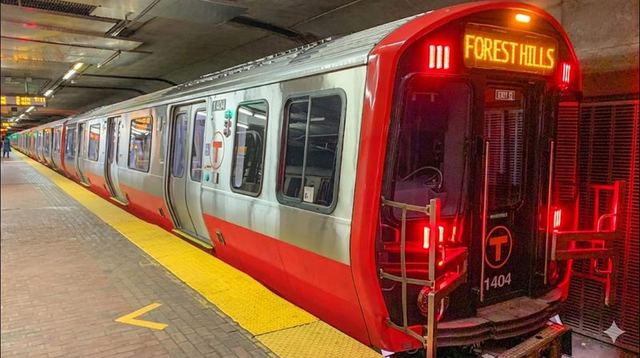
The line's trains are modelled on the MBTA (CRRC) Orange Line 1400-series (see Transitica rolling stock).
History
The MBTA's new Orange Line cars (numbered in the 1400-series) were ordered from CNR, now part of CRRC, on 22 October 2014: 152 cars for $566.6 million, built at a new factory in Springfield, Massachusetts. They replaced the whole fleet of Hawker Siddeley 01200-series cars of 1981, nicknamed the "Orange Blossoms". The first car entered service on 14 August 2019.
The new cars were pulled from service after a derailment on 16 March 2021 (caused partly by faulty side bearer pads), and again in 2022 over a wrongly fitted brake bolt, a battery failure and power cables arcing to the axles. During the month-long closure of the whole Orange Line in August–September 2022 more new cars were brought in, and by 2023 they were going about 114,000 miles between failures. About 150 are now in service.
Design and features
The new cars run as six-car trains with three pairs of doors per side, more room for wheelchairs and pushchairs, LED lighting, digital maps and screens, and security cameras.
Specifications
| Real-world train | |
|---|---|
| Manufacturer | CRRC MA (Springfield, Massachusetts) |
| Entered service | 14 August 2019 |
| Number built | 152 cars |
| Formation | 6 cars |
| Car length | 19.8 m (65 ft) |
| Width | 2.82 m (9 ft 3 in) |
| Doors | 3 pairs per side |
| Traction | IGBT–VVVF, AC motors |
| Electric system | 600 V DC third rail |
In Transitica
When the real MBTA ordered new Orange Line cars from CNR (now CRRC) in 2014, the Transitica MBTA added cars for the Hydrogen line, built at the same new factory in Springfield, Massachusetts. They went through the same troubles: the 2021 derailment and the 2022 brake, battery and cable problems, before settling down as six-car trains.
How the line's trains are set up in the game:
- Cars: 6
- Car Length: 20 m (65.6 ft)
- Platform Length: 121 m (397 ft)
Source: Orange Line (MBTA) on Wikipedia.