
Chi (χ) line: Difference between revisions
| Revision as of 03:21, 24 November 2026 claude (Add the Transitica route-profile document (outdated) to the wiki) | Revision as of 20:55, 25 November 2026 claude (Rolling stock: in-game train settings merged into the specifications table (real world vs In Transitica)) | ||
|---|---|---|---|
| Line 1: | Line 1: | ||
| + | --- | ||
| + | infobox: | ||
| + | Operator: "[[Sayama, Kyokei and Matsuhama Railway Company]]" | ||
| + | Rolling stock: "JR East (Kawasaki, Tokyu Car) E231-0 Series" | ||
| + | --- | ||
| + | {{route}} | ||
| + | |||
## History | ## History | ||
| − | In the [[Transitica]] plan, an older route-profile document for this world that is now out of date, this line was the '''SKMRC Chi Line''' (<span class="chip" style="background:#009cff;color:#fff;border-radius:.8em;min-width:1.6em">χ</span>), a commuter rail line of the [[Sayama, Kyokei and Matsuhama Railway Company]] with 10 stations between Union Square and Matsuhama (松浜). Its ideal rolling stock was the JR East (Kawasaki, Tokyu Car) E231-0 Series (2 cars). | + | The line was first planned as the '''SKMRC Chi Line''' (<img class="chip-img" src="/images/bullet-chi.png" alt="χ" loading="lazy">), a commuter rail line of the [[Sayama, Kyokei and Matsuhama Railway Company]] with 10 stations between Union Square and Matsuhama (松 浜). |
| − | The full old route profile is at [[Chi line (Transitica)]]. | + | Nagaura (なかうら) has since been renamed [[Nakaura]]. |
| + | |||
| + | ## Rolling stock | ||
| + | |||
| + | The line's trains are modelled on the '''JR East (Kawasaki, Tokyu Car) E231-0 Series''' (see [[Transitica rolling stock]]). | ||
| + | |||
| + |  | ||
| + | |||
| + | ### History | ||
| + | |||
| + | The E231 series was JR East's standard commuter and suburban train of the 2000s, developed from the 209 and E217 series and built by Tokyu Car, Kawasaki and JR East's Niitsu factory. It first carried passengers on 13 March 2000, replaced the 103, 113, 115, 201, 205 and 301 series, and has since been followed by the E235. | ||
| + | |||
| + | The E231-0 subseries was the first production version, entering service on the Chūō–Sōbu local line between February 2000 and November 2001; more sets went to the Jōban and Narita lines up to 2005. The Chūō–Sōbu sets each had a six-door car and were refurbished between 2015 and 2020, after which many were shortened to eight cars for the Musashino Line or four cars as the E231-3000. | ||
| + | |||
| + | ### Design and features | ||
| + | |||
| + | The E231 is wider than earlier JR commuter trains (2.95 m against 2.8 m), with stainless-steel bodies, IGBT–VVVF control and regenerative braking. It runs on 1,500 V DC overhead lines and has four pairs of doors per side; some early cars had six pairs to speed up boarding in the rush hour. | ||
| + | |||
| + | ### Specifications | ||
| + | |||
| + | <table class="wikitable rs-specs rs-compare"><tr><th></th><th>Real-world train</th><th>In Transitica</th></tr><tr><th>Manufacturer</th><td>Kawasaki, Tokyu Car</td><td></td></tr><tr><th>Entered service</th><td>2000</td><td></td></tr><tr><th>Formation</th><td>10-car, 10+5-car, 8-car and 4-car sets</td><td></td></tr><tr><th>Cars per train</th><td></td><td>2</td></tr><tr><th>Lines (real world)</th><td>Chūō–Sōbu, Jōban, Narita and Musashino lines</td><td></td></tr><tr><th>Width</th><td>2.95 m (9 ft 8 in)</td><td></td></tr><tr><th>Doors</th><td>4 pairs per side</td><td></td></tr><tr><th>Car body</th><td>stainless steel</td><td></td></tr><tr><th>Car length</th><td>20 m (65 ft 7 in)</td><td>20 m (65.6 ft)</td></tr><tr><th>Maximum speed</th><td>120 km/h (75 mph)</td><td></td></tr><tr><th>Traction</th><td>IGBT–VVVF</td><td></td></tr><tr><th>Electric system</th><td>1,500 V DC overhead line</td><td></td></tr><tr><th>Track gauge</th><td>1,067 mm (3 ft 6 in)</td><td></td></tr><tr><th>Platform length</th><td></td><td>33 m (108.3 ft)</td></tr></table> | ||
| + | |||
| + | ### In Transitica | ||
| + | |||
| + | The Sayama, Kyokei and Matsuhama Railway Company bought the Chi line's train second-hand from JR East: two cars from an E231-0 set retired from the Chūō–Sōbu Line, refurbished to run as the short Chi line's shuttle. | ||
| + | |||
| + | <p class="rs-source">Source: <a href="https://en.wikipedia.org/wiki/E231_series" rel="noopener">E231 series</a> on Wikipedia.</p> | ||
Revision as of 20:55, 25 November 2026
| Chi (χ) | |
|---|---|
| Line of the Transitica Railway Network | |
 | |
| Number | χ |
| Type | High-speed rail |
| Color | #009CFF |
| Operator | Sayama, Kyokei and Matsuhama Railway Company |
| Rolling stock | JR East (Kawasaki, Tokyu Car) E231-0 Series |
| Termini | Matsuhama Union Square |
| Stations | 10 |
| Length | 6,041 blocks (6.0 km) |
| Dimension | minecraft/overworld |
The Chi (χ) Line, numbered χ, is a commuter rail line part of the Sayama, Kyokei and Matsuhama Railway Company in the Transitica Railway Network. It runs between Matsuhama and Union Square, serving 10 stations over about 6.0 km.
Route
| Station | Connections | Platforms | km | |
|---|---|---|---|---|
| Matsuhama |  | 2 | 0.0 | |
| Nakaura | 1 | 1.4 | ||
| Borderville | ▼1 ▲2 | 2.7 | ||
| Farmingville | 1 | 3.0 | ||
| Bayville | ▼2 ▲1 | 3.5 | ||
| Westville | 1 | 3.9 | ||
| Northwesternville | 1 | 4.3 | ||
| Farmlands | 1 | 5.1 | ||
| Uptown Point | 1 | 5.6 | ||
| Union Square | ▼1 ▲2 | 6.0 |
History
The line was first planned as the SKMRC Chi Line (), a commuter rail line of the Sayama, Kyokei and Matsuhama Railway Company with 10 stations between Union Square and Matsuhama (松 浜).
Nagaura (なかうら) has since been renamed Nakaura.
Rolling stock
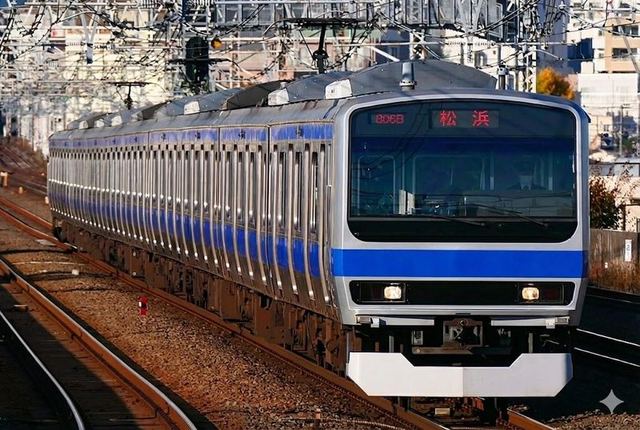
The line's trains are modelled on the JR East (Kawasaki, Tokyu Car) E231-0 Series (see Transitica rolling stock).

History
The E231 series was JR East's standard commuter and suburban train of the 2000s, developed from the 209 and E217 series and built by Tokyu Car, Kawasaki and JR East's Niitsu factory. It first carried passengers on 13 March 2000, replaced the 103, 113, 115, 201, 205 and 301 series, and has since been followed by the E235.
The E231-0 subseries was the first production version, entering service on the Chūō–Sōbu local line between February 2000 and November 2001; more sets went to the Jōban and Narita lines up to 2005. The Chūō–Sōbu sets each had a six-door car and were refurbished between 2015 and 2020, after which many were shortened to eight cars for the Musashino Line or four cars as the E231-3000.
Design and features
The E231 is wider than earlier JR commuter trains (2.95 m against 2.8 m), with stainless-steel bodies, IGBT–VVVF control and regenerative braking. It runs on 1,500 V DC overhead lines and has four pairs of doors per side; some early cars had six pairs to speed up boarding in the rush hour.
Specifications
| Real-world train | In Transitica | |
|---|---|---|
| Manufacturer | Kawasaki, Tokyu Car | |
| Entered service | 2000 | |
| Formation | 10-car, 10+5-car, 8-car and 4-car sets | |
| Cars per train | 2 | |
| Lines (real world) | Chūō–Sōbu, Jōban, Narita and Musashino lines | |
| Width | 2.95 m (9 ft 8 in) | |
| Doors | 4 pairs per side | |
| Car body | stainless steel | |
| Car length | 20 m (65 ft 7 in) | 20 m (65.6 ft) |
| Maximum speed | 120 km/h (75 mph) | |
| Traction | IGBT–VVVF | |
| Electric system | 1,500 V DC overhead line | |
| Track gauge | 1,067 mm (3 ft 6 in) | |
| Platform length | 33 m (108.3 ft) |
In Transitica
The Sayama, Kyokei and Matsuhama Railway Company bought the Chi line's train second-hand from JR East: two cars from an E231-0 set retired from the Chūō–Sōbu Line, refurbished to run as the short Chi line's shuttle.
Source: E231 series on Wikipedia.