
Calcium line
| Calcium | |
|---|---|
| Line of the Transitica Railway Network | |
 | |
| Number | CA |
| Type | High-speed rail |
| Color | #A5AA9D |
| Operator | Massachusetts Bay Transit Authority |
| Division | MBTA Conventional Rail (commuter rail) |
| Rolling stock | JR East E231-800 Series |
| Termini | Pankow Airport Fuel Farm Boston South Station |
| Stations | 6 |
| Length | 5,786 blocks (5.8 km) |
| Dimension | minecraft/overworld |
The Calcium Line, numbered CA, is a commuter rail line part of the Massachusetts Bay Transit Authority in the Transitica Railway Network. It runs between Pankow Airport Fuel Farm and Boston South Station, serving 6 stations over about 5.8 km.
Route
| Station | Connections | Platforms | km | |
|---|---|---|---|---|
| Pankow Airport Fuel Farm | ▼1 ▲2 | 0.0 | ||
| Pankow Airport Terminal A ✈ | ▼2 ▲1 | 0.4 | ||
| Pankow Airport Terminal B ✈ | ▼2 ▲1 | 2.8 | ||
| Machesterford West | ▼2 ▲1 | 4.0 | ||
| Machesterford East |  | ▼3 ▲2 | 5.1 | |
| Boston South Station |   | 2 | 5.8 |
History
The line was first planned as the MBTA Calcium Line (), a commuter rail line of the Massachusetts Bay Transit Authority (MBTA Conventional Rail (commuter rail)) with 6 stations between Boston South Station 🚆 and Pankow Airport Fuel Farm.
Rolling stock
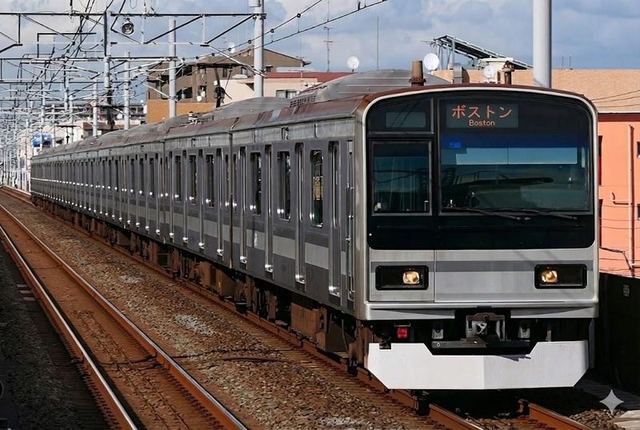
The line's trains are modelled on the JR East E231-800 Series (see Transitica rolling stock).
History
The E231 series was JR East's standard commuter and suburban train of the 2000s, developed from the 209 and E217 series and built by Tokyu Car, Kawasaki and JR East's Niitsu factory. It first carried passengers on 13 March 2000, replaced the 103, 113, 115, 201, 205 and 301 series, and has since been followed by the E235.
The E231-800 subseries was built for through running between the Chūō–Sōbu line and the Tokyo Metro Tōzai Line, which crosses central Tokyo underground. Seven ten-car sets (K1–K7) were delivered between January and May 2003 and entered service on 1 May 2003, replacing the 103 and 301 series. They are kept at Mitaka depot.
Design and features
The E231 is wider than earlier JR commuter trains (2.95 m against 2.8 m), with stainless-steel bodies, IGBT–VVVF control and regenerative braking. It runs on 1,500 V DC overhead lines and has four pairs of doors per side; some early cars had six pairs to speed up boarding in the rush hour. The -800 sets have narrower 2.8 m bodies to fit the Tōzai Line, emergency doors in the cab ends for tunnel evacuation, and extra power for the subway's gradients, with six powered cars in every ten.
Specifications
| Real-world train | |
|---|---|
| Manufacturer | Tokyu Car, JR East Niitsu |
| Entered service | 1 May 2003 |
| Number built | 7 ten-car sets |
| Lines (real world) | Chūō–Sōbu line, Tokyo Metro Tōzai Line |
| Width | 2.8 m (9 ft 2 in) |
| Doors | 4 pairs per side |
| Car body | stainless steel |
| Car length | 20 m (65 ft 7 in) |
| Maximum speed | 120 km/h (75 mph) |
| Traction | IGBT–VVVF |
| Electric system | 1,500 V DC overhead line |
| Track gauge | 1,067 mm (3 ft 6 in) |
In Transitica
How the line's trains are set up in the game:
- Cars: 2
- Car Length: 20 m (65.6 ft)
- Platform Length: 30 m (98.4 ft)
Source: E231 series on Wikipedia.