
Azure line: Difference between revisions
| Revision as of 03:21, 24 November 2026 claude (Add the Transitica route-profile document (outdated) to the wiki) | Revision as of 20:55, 25 November 2026 claude (Rolling stock: in-game train settings merged into the specifications table (real world vs In Transitica)) | ||
|---|---|---|---|
| Line 1: | Line 1: | ||
| + | --- | ||
| + | color: "#0080FF" | ||
| + | infobox: | ||
| + | Operator: "[[Greenfield Transit Authority]]" | ||
| + | Division: "GTA Subway" | ||
| + | Rolling stock: "MTA R110A" | ||
| + | --- | ||
| + | {{route}} | ||
| + | |||
## History | ## History | ||
| − | In the [[Transitica]] plan, an older route-profile document for this world that is now out of date, this line was the '''GTA Azure Line''' (<span class="chip" style="background:#0080ff;color:#fff;border-radius:.8em;min-width:1.6em">AZ</span>), a subway line of the [[Greenfield Transit Authority]] with 8 stations between 新鶴川 (Shintsurukawa) and Longport Keys West. Its ideal rolling stock was the MTA R110A (3 cars). On the Unnamed corridor (along the Gray line) it ran express, skipping Lincoln Port, Greenfield Bus Terminal, Market Street, Park Avenue, Ashfield Park, Genmar Stadium, Clinton and Melrose West. | + | The line was first planned as the '''GTA Azure Line''' (<img class="chip-img" src="/images/bullet-azure.png" alt="AZ" loading="lazy">), a subway line of the [[Greenfield Transit Authority]] (GTA Subway) with 8 stations between 新鶴川 (Shintsurukawa) and Longport Keys West. |
| − | The full old route profile is at [[Azure line (Transitica)]]. | + | 京慧中央 (Kyokei Central) has since been renamed [[Kyōkei-Chūō]]; 京慧西 (Kyokei West) has since been renamed [[Kyōkei-Nishi]]; 京慧道 (Kyokei Road) has since been renamed [[Kyōkeidō]]. |
| + | |||
| + | ## Operations | ||
| + | |||
| + | - '''Unnamed corridor (along the Gray line):''' runs express, skipping Lincoln Port, Greenfield Bus Terminal, Market Street, Park Avenue, Ashfield Park, Genmar Stadium, Clinton and Melrose West; shares the corridor with <a href="/wiki/Gray_line" class="chip-link" title="Gray line"><img class="chip-img" src="/images/bullet-gray.png" alt="GY" loading="lazy"></a> [[Gray line]] (local) (see [[Express and local sections]]). | ||
| + | |||
| + | ## Rolling stock | ||
| + | |||
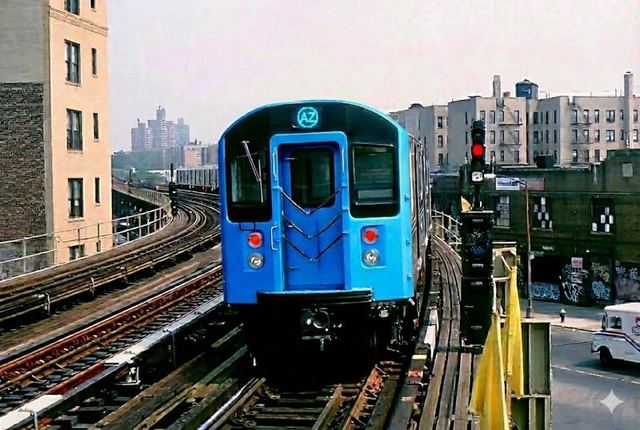
| + | The line's trains are modelled on the '''MTA R110A''' (see [[Transitica rolling stock]]). | ||
| + | |||
| + |  | ||
| + | |||
| + | ### History | ||
| + | |||
| + | In 1989 the MTA ordered two prototype New Technology Test Trains to try out ideas for its next generation of subway cars: the R110A for the numbered A Division lines and the R110B for the lettered B Division. Kawasaki built the ten R110A cars in Kobe in 1992, as two permanently coupled five-car sets, at about $2.2 million per car. They were never meant for long production runs; their job was to prove the technology for the R142 and R142A orders. | ||
| + | |||
| + | The R110As entered service on the 2 on 15 June 1993. They were taken out of service in spring 1998 after brake problems and a fire, and sat in IRT yards until 2013. Their six middle cars were then turned into hose-reach work cars, and from 2022 Brookville has been converting the four cab cars into pump and generator cars. | ||
| + | |||
| + | ### Design and features | ||
| + | |||
| + | The R110A has squarer ends than the R62s it was compared with, and six 63-inch doors per car, more than a foot wider than the standard 50-inch door, staggered on each side to help people get on and off. Clear Lexan glass at the car ends lets riders see into the next car. Massimo Vignelli designed the interior for the Arts for Transit programme, with graffiti-resistant fibreglass, bright colours, speckled floors and rounded fittings, and benches mixing side-facing and forward-facing seats. Seats per train fell from 440 to 264 in exchange for much more standing room, a change later partly reversed on the R142. | ||
| + | |||
| + | The R110A and R110B were the first New York subway cars with recorded announcements. They also tested AC propulsion with regenerative braking, computer-controlled doors and brakes, roof-mounted air conditioning, air-bag suspension, intercoms, LED line indicators and next-stop signs, and a computerised cab with a single control lever and an LCD screen. | ||
| + | |||
| + | ### Specifications | ||
| + | |||
| + | <table class="wikitable rs-specs rs-compare"><tr><th></th><th>Real-world train</th><th>In Transitica</th></tr><tr><th>Manufacturer</th><td>Kawasaki (Kobe, Japan)</td><td>Kawasaki</td></tr><tr><th>Built</th><td>1992</td><td></td></tr><tr><th>Entered service</th><td>15 June 1993</td><td></td></tr><tr><th>Retired</th><td>1998</td><td></td></tr><tr><th>Number built</th><td>10 cars (two five-car sets)</td><td></td></tr><tr><th>Formation</th><td>A-B-B-B-A</td><td></td></tr><tr><th>Cars per train</th><td></td><td>3</td></tr><tr><th>Car length</th><td>15.65 m (51 ft 4 in)</td><td>15.65 m (51 ft 4 in)</td></tr><tr><th>Width</th><td>2.67 m (8 ft 9 in)</td><td></td></tr><tr><th>Height</th><td>3.62 m (11 ft 10.5 in)</td><td></td></tr><tr><th>Doors</th><td>6 × 63 in (1.6 m) per car, 3 per side</td><td></td></tr><tr><th>Maximum speed</th><td>89 km/h (55 mph)</td><td>89 km/h (55 mph)</td></tr><tr><th>Weight</th><td>30.6–33 t per car</td><td></td></tr><tr><th>Capacity</th><td>24–28 seated per car</td><td></td></tr><tr><th>Traction</th><td>GTO–VVVF (AEG/Adtranz), 150 hp AC motors</td><td></td></tr><tr><th>Electric system</th><td>625 V DC third rail</td><td>third rail, 625 V DC</td></tr><tr><th>Platform length</th><td></td><td>60 m (197 ft)</td></tr><tr><th>Acceleration</th><td></td><td>1.1 m/s²</td></tr><tr><th>Deceleration</th><td></td><td>1.3 m/s².</td></tr></table> | ||
| + | |||
| + | ### In Transitica | ||
| + | |||
| + | The Azure line was the GTA's test line. In 1993, when New York's New Technology Test Trains went into service, Kawasaki built an extra short R110A set at Kobe for the GTA to try out AC propulsion, wide doors and recorded announcements in Greenfield. Like New York's, it suffered brake problems, but the GTA kept it running on the short Azure line, where its three wide doors per side suit the line's crowded stations. | ||
| + | |||
| + | <p class="rs-source">Source: <a href="https://en.wikipedia.org/wiki/R110A_(New_York_City_Subway_car)" rel="noopener">R110A (New York City Subway car)</a> on Wikipedia.</p> | ||
Revision as of 20:55, 25 November 2026
| Azure | |
|---|---|
| Line of the Transitica Railway Network | |
 | |
| Number | AZ |
| Type | Rapid transit |
| Color | #0080FF |
| Operator | Greenfield Transit Authority |
| Division | GTA Subway |
| Rolling stock | MTA R110A |
| Termini | Longport Keys West Shin-Tsurukawa |
| Stations | 8 |
| Length | 12,246 blocks (12.2 km) |
| Dimension | minecraft/overworld |
The Azure Line, numbered AZ, is a subway line part of the Greenfield Transit Authority in the Transitica Railway Network. It runs between Longport Keys West and Shin-Tsurukawa, serving 8 stations over about 12.2 km.
Route
| Station | Connections | Platforms | km | |
|---|---|---|---|---|
| Longport Keys West |  | ▼3 ▲2 | 0.0 | |
| Lincoln Port | ||||
| Greenfield Bus Terminal | ||||
| Market Street | ||||
| Greenfield Union Terminal |          | ▼9 ▲8 | 1.3 | |
| Park Avenue | ||||
| Ashfield Park | ||||
| Genmar Stadium | ||||
| Clinton | ||||
| Melrose South |  | ▼8 ▲9 | 2.9 | |
| Melrose North |  | ▼3 ▲2 | 4.7 | |
| Kyōkei-Chūō | | ▼2 ▲3 | 8.0 | |
| Kyōkei-Nishi |  | ▼B ▲A | 9.7 | |
| Kyōkeidō | ▼1 ▲2 | 11.1 | ||
| Shin-Tsurukawa | | ▼3 ▲4 | 12.2 | |
History
The line was first planned as the GTA Azure Line (), a subway line of the Greenfield Transit Authority (GTA Subway) with 8 stations between 新鶴川 (Shintsurukawa) and Longport Keys West.
京慧中央 (Kyokei Central) has since been renamed Kyōkei-Chūō; 京慧西 (Kyokei West) has since been renamed Kyōkei-Nishi; 京慧道 (Kyokei Road) has since been renamed Kyōkeidō.
Operations
- Unnamed corridor (along the Gray line): runs express, skipping Lincoln Port, Greenfield Bus Terminal, Market Street, Park Avenue, Ashfield Park, Genmar Stadium, Clinton and Melrose West; shares the corridor with Gray line (local) (see Express and local sections).
Rolling stock
The line's trains are modelled on the MTA R110A (see Transitica rolling stock).

History
In 1989 the MTA ordered two prototype New Technology Test Trains to try out ideas for its next generation of subway cars: the R110A for the numbered A Division lines and the R110B for the lettered B Division. Kawasaki built the ten R110A cars in Kobe in 1992, as two permanently coupled five-car sets, at about $2.2 million per car. They were never meant for long production runs; their job was to prove the technology for the R142 and R142A orders.
The R110As entered service on the 2 on 15 June 1993. They were taken out of service in spring 1998 after brake problems and a fire, and sat in IRT yards until 2013. Their six middle cars were then turned into hose-reach work cars, and from 2022 Brookville has been converting the four cab cars into pump and generator cars.
Design and features
The R110A has squarer ends than the R62s it was compared with, and six 63-inch doors per car, more than a foot wider than the standard 50-inch door, staggered on each side to help people get on and off. Clear Lexan glass at the car ends lets riders see into the next car. Massimo Vignelli designed the interior for the Arts for Transit programme, with graffiti-resistant fibreglass, bright colours, speckled floors and rounded fittings, and benches mixing side-facing and forward-facing seats. Seats per train fell from 440 to 264 in exchange for much more standing room, a change later partly reversed on the R142.
The R110A and R110B were the first New York subway cars with recorded announcements. They also tested AC propulsion with regenerative braking, computer-controlled doors and brakes, roof-mounted air conditioning, air-bag suspension, intercoms, LED line indicators and next-stop signs, and a computerised cab with a single control lever and an LCD screen.
Specifications
| Real-world train | In Transitica | |
|---|---|---|
| Manufacturer | Kawasaki (Kobe, Japan) | Kawasaki |
| Built | 1992 | |
| Entered service | 15 June 1993 | |
| Retired | 1998 | |
| Number built | 10 cars (two five-car sets) | |
| Formation | A-B-B-B-A | |
| Cars per train | 3 | |
| Car length | 15.65 m (51 ft 4 in) | 15.65 m (51 ft 4 in) |
| Width | 2.67 m (8 ft 9 in) | |
| Height | 3.62 m (11 ft 10.5 in) | |
| Doors | 6 × 63 in (1.6 m) per car, 3 per side | |
| Maximum speed | 89 km/h (55 mph) | 89 km/h (55 mph) |
| Weight | 30.6–33 t per car | |
| Capacity | 24–28 seated per car | |
| Traction | GTO–VVVF (AEG/Adtranz), 150 hp AC motors | |
| Electric system | 625 V DC third rail | third rail, 625 V DC |
| Platform length | 60 m (197 ft) | |
| Acceleration | 1.1 m/s² | |
| Deceleration | 1.3 m/s². |
In Transitica
The Azure line was the GTA's test line. In 1993, when New York's New Technology Test Trains went into service, Kawasaki built an extra short R110A set at Kobe for the GTA to try out AC propulsion, wide doors and recorded announcements in Greenfield. Like New York's, it suffered brake problems, but the GTA kept it running on the short Azure line, where its three wide doors per side suit the line's crowded stations.
Source: R110A (New York City Subway car) on Wikipedia.